Tag: Nebulae

  • Trifid Nebula M20

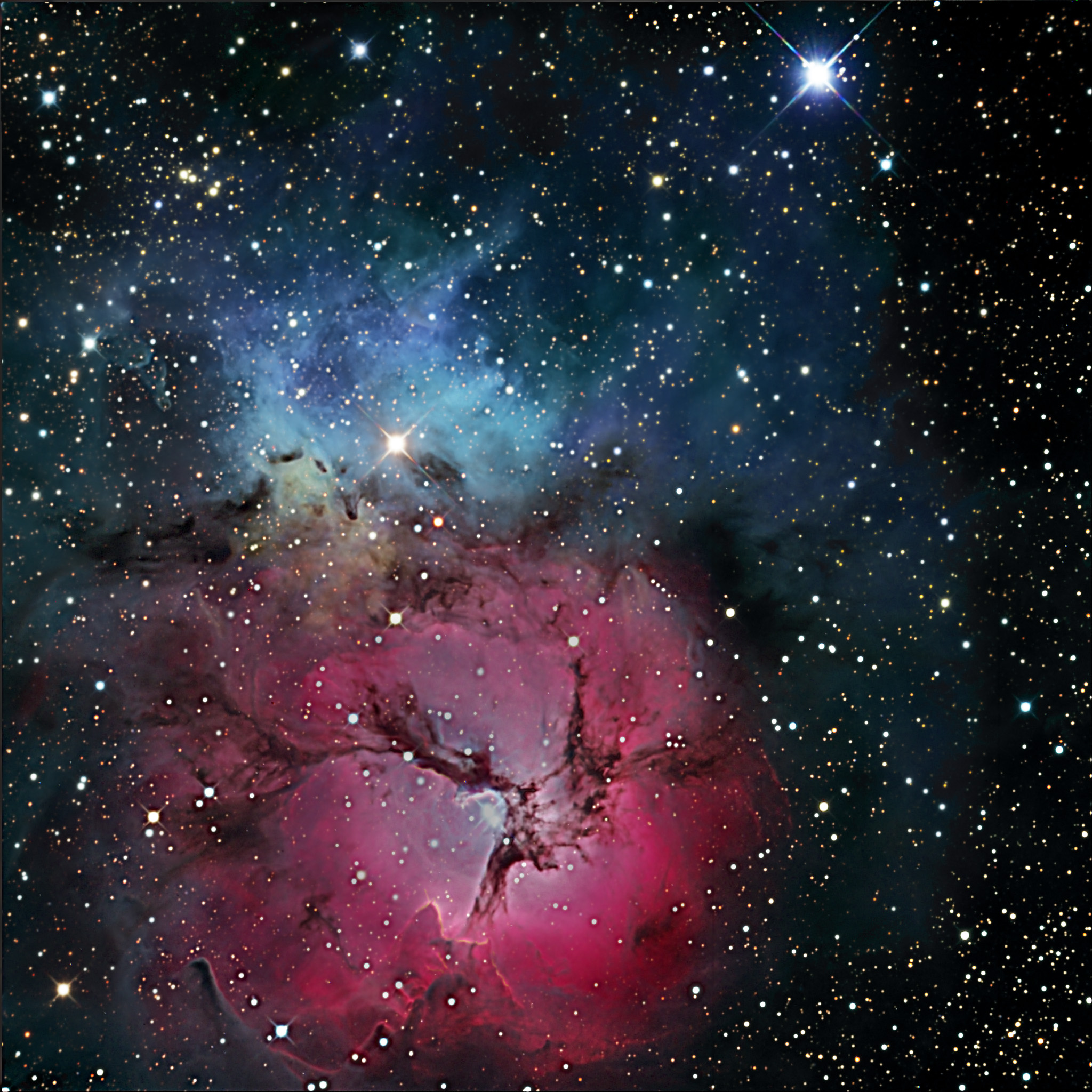
    The Trifid Nebula (M20, also known as NGC 6514)

    I’m very pleased with this one!! This project was nearly 2 months in the making, but it was worth it.

    In my opinion, the Trifid is one of the very prettiest objects in the sky, at least in the Northern Hemisphere. It’s full of rich colors and fine details in the dust lanes and gaseous structures.

    I was blown away by the result I got; the image was stunning! I was especially pleased with the details in the dark dust lanes, the range of colors in the emission and reflection parts of the nebula, and the overall 3D appearance of the puffy clouds. Then, another surprise. While examining the image in detail I noticed a tiny but clear straight line jutting out from one of the clouds near the bottom. Was that an artifact, or could it be… ? I checked the Hubble archive and found what I was looking for – a high resolution close-up of the region in question and sure enough, it was an actual stellar jet! This was the first time I had captured anything like this and it was the icing on the cake:
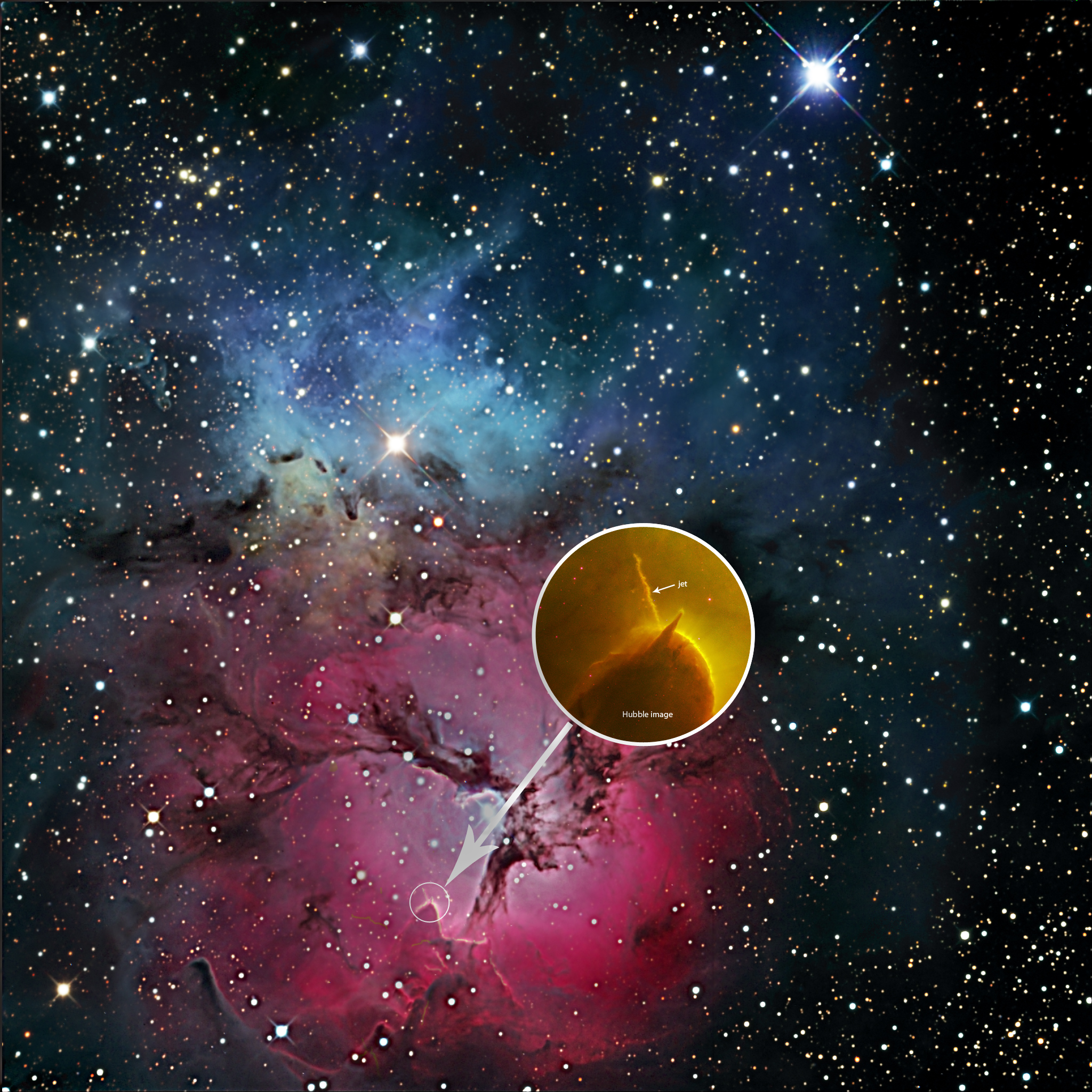
    Jet in M20

    The jet itself is quite interesting:

    “A stellar jet [the thin, wispy object pointing to the upper left] protrudes from the head of a dense cloud and extends three-quarters of a light-year into the nebula. The jet’s source is a very young stellar object that lies buried within the cloud. Jets such as this are the exhaust gases of star formation. Radiation from the massive star at the center of the nebula is making the gas in the jet glow, just as it causes the rest of the nebula to glow.

    The jet in the Trifid is a “ticker tape,” telling the history of one particular young stellar object that is continuing to grow as its gravity draws in gas from its surroundings. But this particular ticker tape will not run for much longer. Within the next 10,000 years the glare from the central, massive star will continue to erode the nebula, overrunning the forming star, and bringing its growth to an abrupt and possibly premature end.”

    – Hartmut Frommert & Christine Kronberg (SEDS)

    The shorter spike pointed about 45° clockwise from the jet is a knot of denser material resisting the stellar wind “blowing” the less dense material around it.

    This is certainly my best astronomical image so far.

    [32″ RC f/7 with SBIG STX KAF-16803 16 megapixel camera @ Mount Lemmon SkyCenter, Arizona]
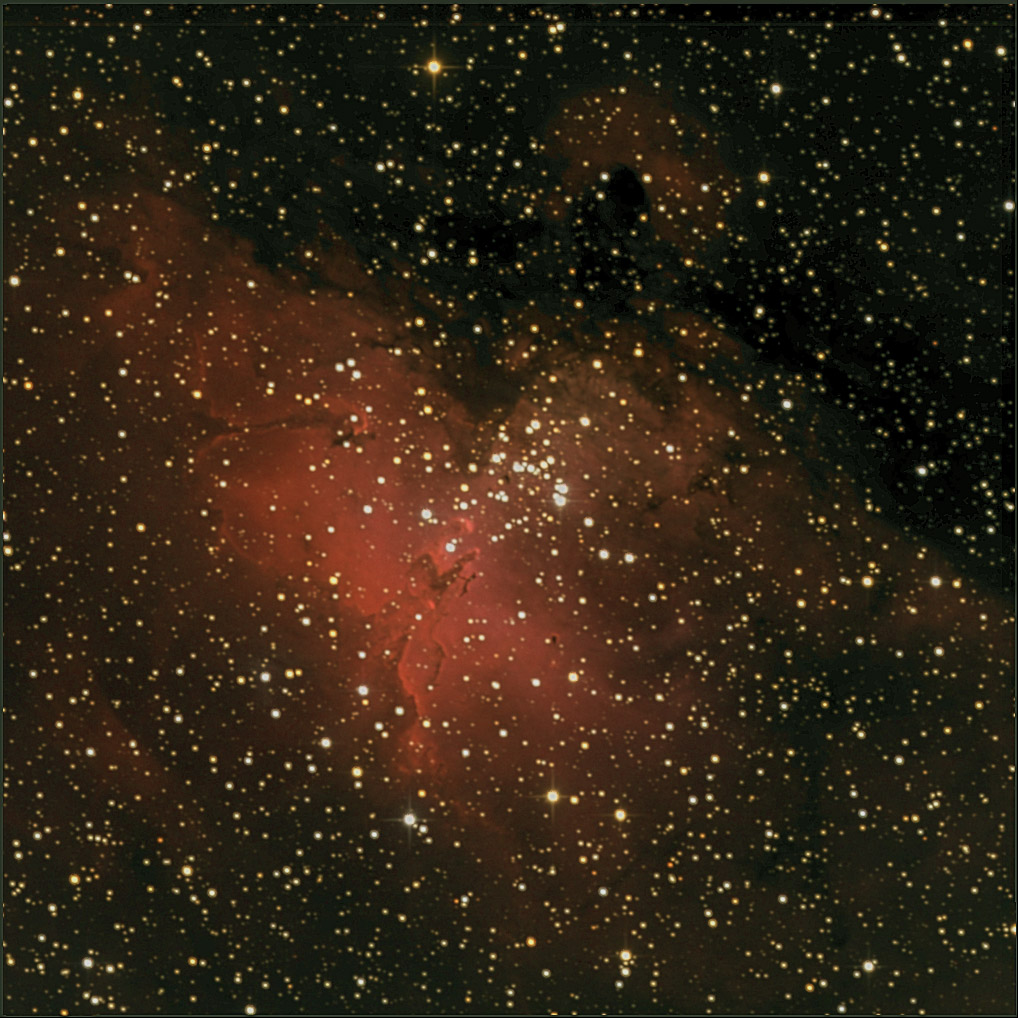
  • Eagle Nebula (M16)

    Eagle nebula – M16

    The Eagle Nebula M16. It’s called that because somebody thought the dark shapes in the center looked like an eagle taking flight.  Does it look like that to you?

    The central part might seem familiar to some of you; it was made famous in a Hubble image dubbed “Pillars of Creation”:

    Hubble image

    That’s a closeup of the central region (rotated 45 deg counterclockwise).


    [20″ CDK f/6.8 with FLI PL09000 camera @ Mt. Teide Observatory, Canary Islands, Spain]

  • Snake Nebula

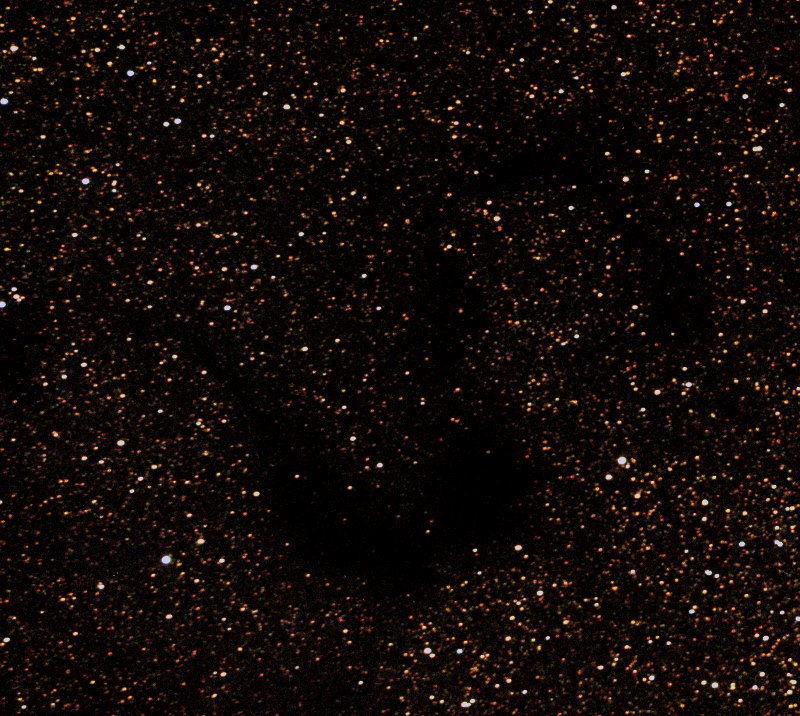
    The Snake Nebula. This one is interesting because it’s defined not by its brightness, but by its *darkness*. Western cultures tended to name only the bright things in the sky, but other cultures such as the Incas also named the dark regions in the sky. Positive space and Negative space. Both equally important.

    The black is clouds of dust and gas blocking the light from the stars behind them. It may stay black for billions of years until a star comes nearby it; then it would glow pink and blue from reflected and emitted light.

    The Incas believed the bright constellations represented animals, but inanimate ones; they believed the dark regions represented *living* animals.

    [3″ APO refractor f/7 with ST-2000XM 2 megapixel camera @ Mt. Teide, Canary Islands, Spain]

  • Flaming Star Nebula (IC 405)

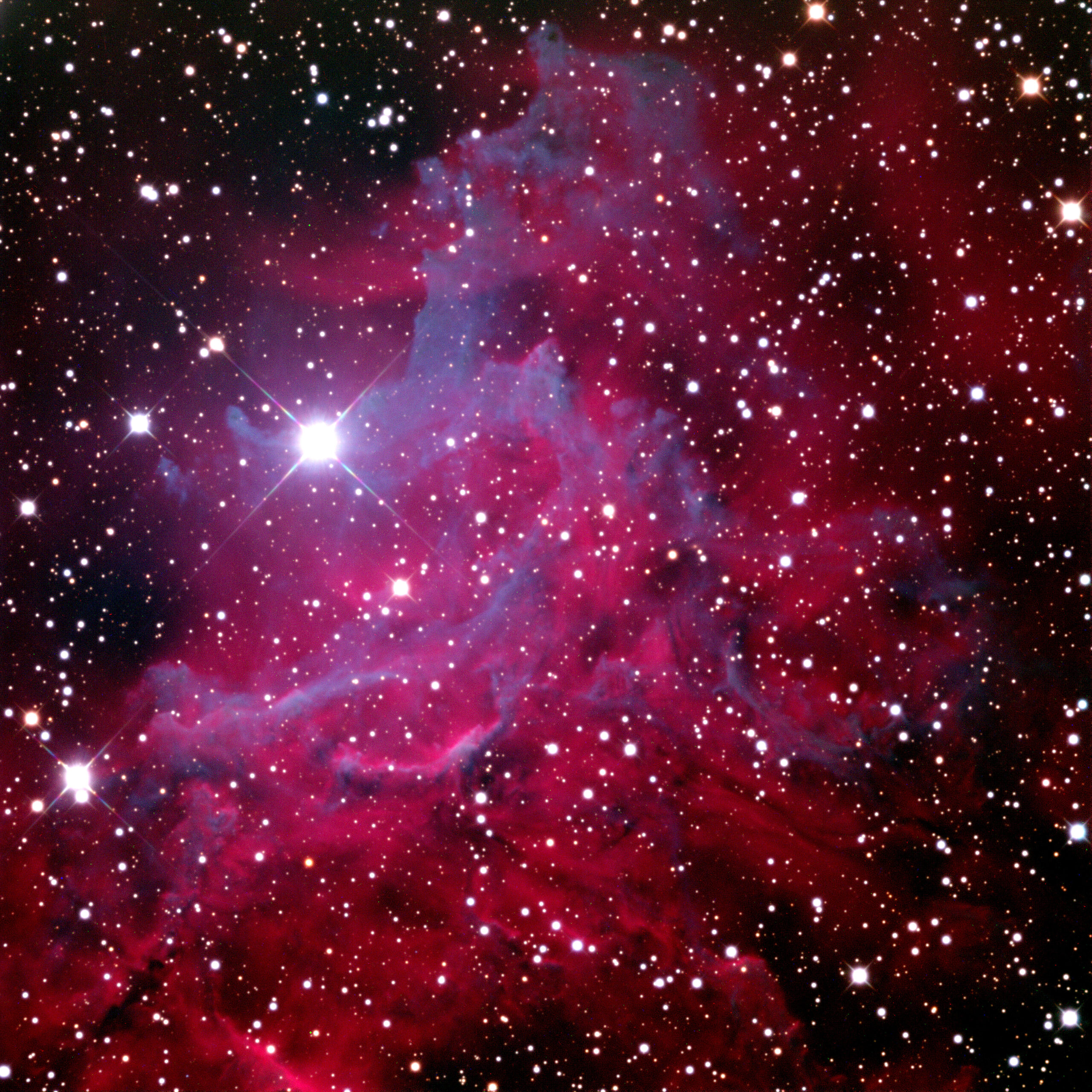
    IC 405 [Joint credit with Adam Block/Mt. Lemmon Skycenter, December 9, 2012]


    IC 405 – also known as the “Flaming Star” nebula in the constellation Auriga.

    What is a nebula?

    A nebula is a giant cloud of dust and gas.  IC 405 is an emission/reflection nebula which means the gaseous part (mostly hydrogen) is glowing due to being heated up by the nearby star (brightest star in the image) — this is the red part; and the bluish parts are the dust reflecting the starlight.  It’s 1500 light years away and is 5 light years (about 30 trillion miles) in size.

    There is an interesting fact about the star that’s lighting up the nebula.  It wasn’t always there; it actually came from the region of Orion’s belt and was part of a binary star system there.  Something happened to make the pair unstable and both stars shot off at high speed in opposite directions (and still going today).  One of them happens to be passing through this nebula (which is why we can even see it) and the other is exactly the same distance away from Orion’s belt in the opposite direction.

    Technical details:  telescope:  32″ ritchey-chretien design at f/7; SBIG CCD camera at 4096×4096 pixel resolution; exposure was 8 sets of 15 minute exposures for each of the color channels R,G,B binned 1×1 giving a total of 6 hours of exposure time (object was bright enough that a separate Luminance channel was not necessary).  Of the 8 sets, 3 had to be rejected due to poor seeing conditions (there was some high altitude turbulence in the atmosphere that night), so this image is not as perfectly sharp as it could be.