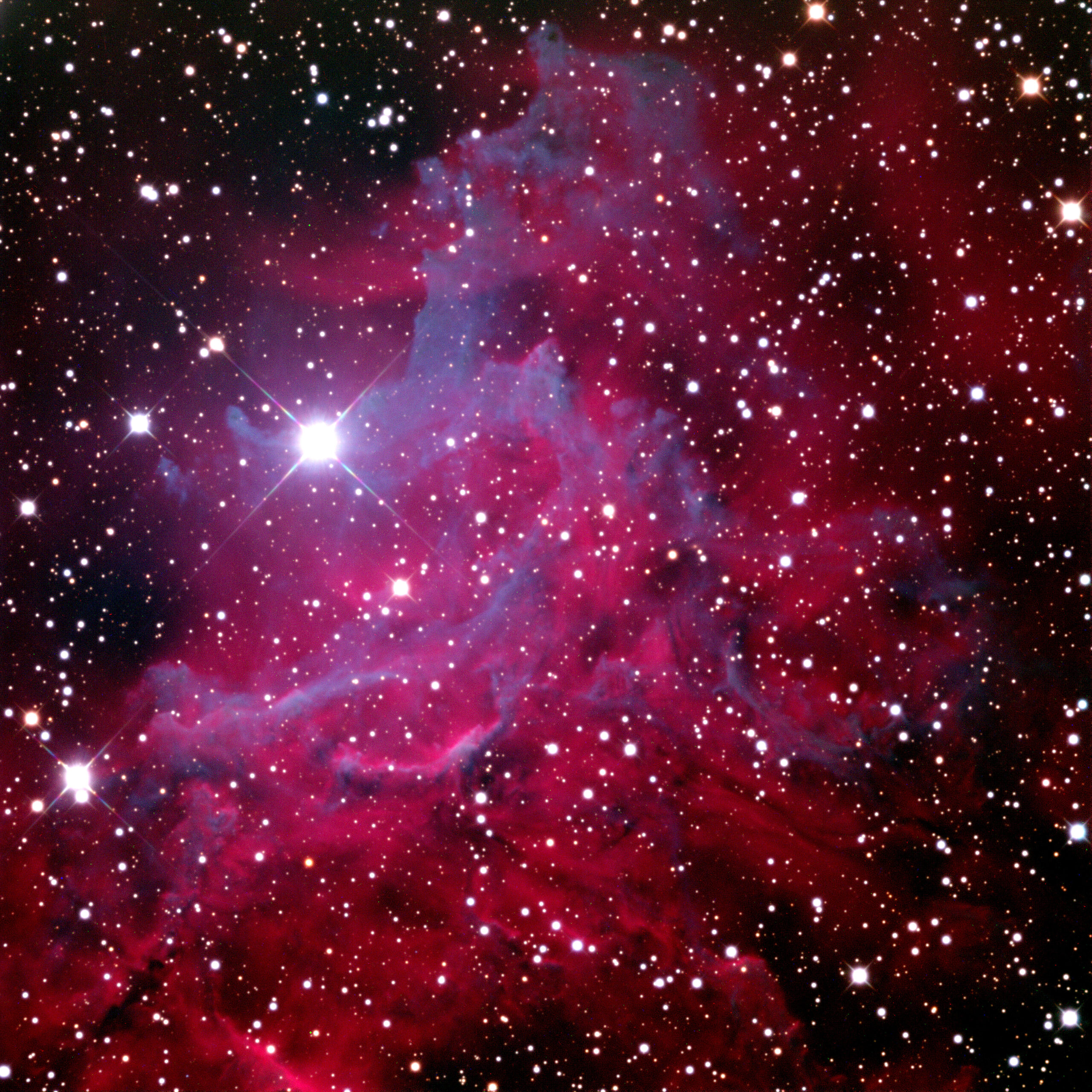
IC 405 [Joint credit with Adam Block/Mt. Lemmon Skycenter, December 9, 2012]
IC 405 – also known as the “Flaming Star” nebula in the constellation Auriga.
What is a nebula?
A nebula is a giant cloud of dust and gas. IC 405 is an emission/reflection nebula which means the gaseous part (mostly hydrogen) is glowing due to being heated up by the nearby star (brightest star in the image) — this is the red part; and the bluish parts are the dust reflecting the starlight. It’s 1500 light years away and is 5 light years (about 30 trillion miles) in size.
There is an interesting fact about the star that’s lighting up the nebula. It wasn’t always there; it actually came from the region of Orion’s belt and was part of a binary star system there. Something happened to make the pair unstable and both stars shot off at high speed in opposite directions (and still going today). One of them happens to be passing through this nebula (which is why we can even see it) and the other is exactly the same distance away from Orion’s belt in the opposite direction.
Technical details: telescope: 32″ ritchey-chretien design at f/7; SBIG CCD camera at 4096×4096 pixel resolution; exposure was 8 sets of 15 minute exposures for each of the color channels R,G,B binned 1×1 giving a total of 6 hours of exposure time (object was bright enough that a separate Luminance channel was not necessary). Of the 8 sets, 3 had to be rejected due to poor seeing conditions (there was some high altitude turbulence in the atmosphere that night), so this image is not as perfectly sharp as it could be.